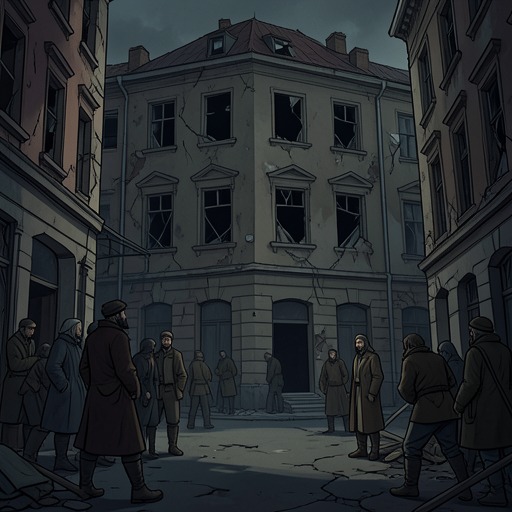
Rodney Barrett
Bird BoxRodney Barrett, the last radio DJ the Shillingham house community can hear, embodies the dwindling connection between isolated survivors and the outside world. His broadcasts offer no reliable new information, yet his presence on the radio matters precisely because so much else has fallen silent; when his voice finally stops, the community hears not only the end of a broadcast but the disappearance of one of its last links to a wider human world.
Identity and Role
During the early collapse, the housemates rely on the radio as their only remaining source of news. Rodney is the last DJ still broadcasting. He has little useful information to offer: he rambles, becomes angry, swears, and has even been heard sleeping on air. The broadcast persists less as a dependable news service than as evidence that someone beyond the house is still speaking.
Malorie understands why the housemates keep listening. Rodney’s voice may sit quietly in the background or fill the dining room, but either way it connects the sealed household to a world from which they are increasingly cut off. For Malorie, who already feels trapped in a vault with her baby, that auditory connection is emotionally consequential even when the news itself has run out.
The Broadcast and Its End
At a gathering in the house, Cheryl raises the radio’s volume because Rodney sounds more depressed than usual. His words turn directly toward the creatures: he asks what they have taken, what they are doing, and whether they have any purpose. Don joins Cheryl beside the radio, Jules turns toward it, and Tom stops playing Gershwin’s “I Got Rhythm.” Tom remarks that he has never heard Rodney address the creatures directly before.
Don predicts that Rodney is going to kill himself. Malorie initially wants to silence Don, but then hears the desolation in Rodney’s voice herself. Rodney says, “Today I’m gonna cheat you,” and describes taking first the one thing he has left that the creatures can take from him. Cheryl reacts in alarm. The radio then falls silent. The scene turns a familiar, imperfect broadcast into a final address and leaves the household without the voice it had continued to use as a tether to the outside.
Media and the Collapse of Public Life
Rodney’s radio presence belongs to a broader breakdown in how people receive news. Earlier, reports of the “Russia Report” spread across the Internet, describing apparently senseless acts of extreme violence in Russia; television then carries an account of events in Alaska. As the crisis worsens, Fox News repeatedly names “The Problem,” while government instructions appear on screen: a national curfew, locked doors, covered windows, and a warning not to look outside. On the radio, music gives way entirely to discussion.
That progression—from online stories and television reports to a radio voice with no new facts—shows public communication contracting under the disaster. The radio remains audible, but its capacity to explain events has failed. Rodney’s eventual silence makes that failure concrete: the survivors lose not just another source of information, but the last broadcast voice they know to be reaching them.
Narrative Significance
Rodney’s broadcast is heard within an intimate domestic scene: Tom’s piano playing stops, the housemates orient themselves toward the radio, and the shared listening gives way to a silence no one can fill. The contrast between music and Rodney’s address makes the broadcast’s emotional force palpable without making it a source of rescue or explanation.
The radio’s changing function also anticipates the survivors’ later dependence on deliberately engineered sound. At Tucker, Rick explains that a motion-activated speaker plays a repeated forty-second recording on a loop for thirty minutes, guiding arrivals to the facility and telling them when they must open their eyes. Rodney’s live, fading voice and Rick’s fixed recording serve different purposes, but both show sound taking on practical importance when sight and ordinary communication are unsafe. Rodney’s broadcasts are a fragile remnant of public life; the later recording turns sound into a controlled survival signal.